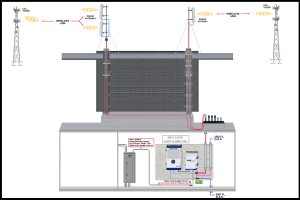
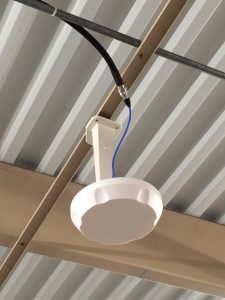
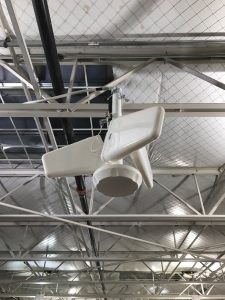
There is a method to ensuring a DAS functions optimally as designed. It first starts by obtaining the floor plan of the building you need to cover or, the topographical map of the outdoor area in question. This will determine the volume of the space to be covered and thus the composite power required to cover this space. Once this is determined, its then a case of distributing this power over the entire area as evenly as possible. To achieve this, the right number and type of antennas are needed. At JDTECK, we spec our repeater systems by the overall volume of area you need to cover. This leaves you with the flexibility and peace of mind to add any number of antennas needed to cover any part of the area. Reason being, because the overall volume of space was already accounted for. After this we then engineer how we will effectively and efficiently to distribute this RF power over the DAS.

Think of your building as a large field that needs water irrigation. The water (source signal) is supplied to your property by the service provider. The cellular repeater is the “water pump” that’s needed to push that water (signal) throughout your field (building). To do so however, we need to design a really good sprinkler system (Distributed Antenna System) that will evenly distribute the water and at a pressure that will provide effective irrigation but, at the same time, will not damage the landscape.
In order to accomplish this, you need all your sprinkler heads (Indoor antennas) placed in the right places with the correct amount of pressure (signal strength) and spray pattern (various styles of antenna radiating patters) for the desired area of coverage. The result is the sprinkler head (service antenna) that nearest to the water pump (cellular repeater) needs to have just the right amount of pressure, as does the sprinkler head furthest away from the pump. This is where a well-designed distributed antenna grid or system which calculates the entire flow path (link budget) comes into place. It is for this reason that you will not see our system designs with an under budgeted amount of service antennas with the hopes of just blasting a signal throughout the building using a high-powered repeater (pump). That’s like taking a fire hose to water your plants. It will not only lack energy-efficiency in getting the job done, but it can also cause damage. Besides increasing the noise floor of the local network beyond necessity, it can damage your system.
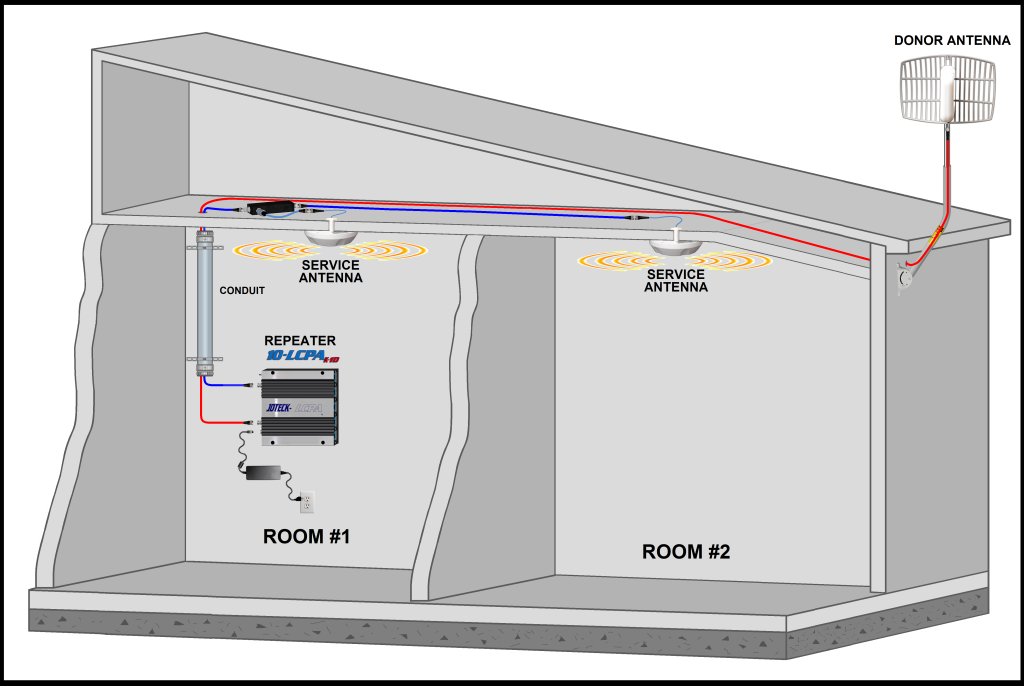
Like sprinkler heads, antennas are a nominal cost to the overall system. Since the output power has already been accounted for by the appropriate repeater selected for the size area you need to cover, it would therefore be wise to get the most out of your system by deploying just the right number of antennas to ensure even power distribution across the space at optimal power levels. By the use of directional couplers and by properly understanding the port / power distribution of these components, you can have a well optimized DAS that will run cool and trouble-free for many years to come.
JDTECK has perfected the art of how to design these systems, using the appropriate values of couplers for even power distribution, no matter how the space is laid out. This results in a highly efficient DAS that has very good throughput speeds and no passive inter-modulation (PIM). Let JDTECK engineer a DAS for you.