Background
The Massachusetts Department of Conservation and Recreation (DCR) continues to invest in technology that improves critical communication functions for daily business processes, visitor experiences, and emergency response throughout its park system. After evaluating solutions proposed by major wireless operators, DCR designates JDTECK as the preferred vendor for these O-DAS (Outdoor DAS) solutions, based on track record, cost, performance, reliability and technical support.
Several parks—including Walden Pond, Horseneck Beach, College Pond, and Fearing Pond—were determined to have sufficient multi-carrier signal (Verizon, AT&T, T-Mobile) at elevated heights (25–60 feet above ground) to justify implementation of a multi-carrier neutral host cellular boosting system. These locations experienced persistent coverage gaps at ground level, resulting in:
• Poor operational communication between staff
• Inability for visitors to reliably access DCR’s mobile parking systems
• Reduced effectiveness of emergency and safety operations
• Visitor frustration when attempting calls, texts, or digital payments
Due to ongoing growth in park attendance, multiple emergency incidents in recent years, and heightened expectations for digital accessibility, DCR has prioritized infrastructure improvements related to wireless connectivity. DCR was losing hundreds of thousands of dollars per park per year, prior to JDTECK’s O-DAS solutions being deployed.
Goal
The primary goal of the O-DAS solution was to improve multi-carrier cellular coverage in parking areas and adjacent day-use zones across four park sites. Enhanced coverage supports the following:
• Reliable access to DCR’s Yodel parking app
• Improved daily operational communications between staff
• Increased safety and emergency response capability
• Reduced visitor wait times at pay stations
• Payment verification of park access via cellular plate readers

Each site required a custom RF plan based on geography, vegetation density, elevation changes, available donor signal strength, and local infrastructure.
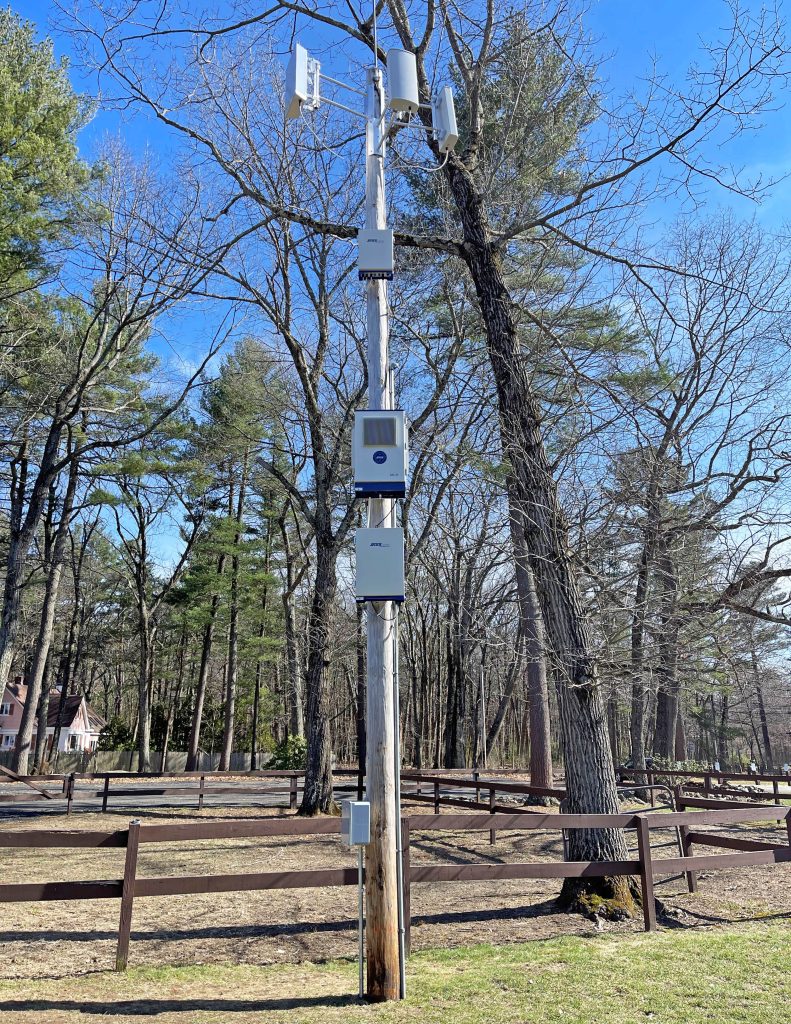
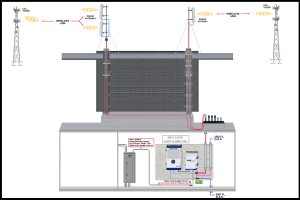
JDTECK’s multi-cellular boosting system uses a donor pole to capture available carrier signals, a service pole to distribute the amplified signal, and a repeater mounted near the base of the service pole. A coax cable run—either aerial or through buried conduit—connects donor and service poles. Antennas mounted at the top of each pole manage directional signal propagation.
Variables such as vegetation, terrain, elevation gradients, and existing obstructions result in differing signal propagation footprints across each site. One site uses an eFemto radio as the source signal for the O-DAS solution.
Conclusion
JDTECK’s multi-signal booster installations across Walden Pond, Horseneck Beach, College Pond, and Fearing Pond have significantly improved operational communications, enhanced visitor experience, and increase staff responsiveness during emergency situations. Each site plan was tailored to local topology, vegetation density, existing infrastructure constraints, and environmental requirements, providing a sustainable connectivity solution across four of Massachusetts’ most visited outdoor recreation areas.